Monday, July 4, 2016

JUSTICE FOR ALL AND ENLIGHTENED MODERATION

http://www.pakistantoday.com.pk/2016/07/04/comment/justice-for-all-and-enlightened-moderation/

Why should the religious brigade be above the law?

All those catchphrases: ‘Quit India,’ ‘Bremain or Brexit?’ ‘Make America great again,’ And here in Pakistan our home grown ‘Roti, kapra aur makan,’ and Asif Ali Zardari’s ‘Pakistan khapay’ in Sindhi, which funnily enough in Urdu and Punjabi means exactly the opposite of ‘Long Live Pakistan!’ That’s politicians for you. Their careers hinge on catchphrases and slogans by means of which they advertise themselves. But they’re not the only ones who thrive on slogans.
There’s another segment of society that uses slogans as labels with far more dire consequences, and that’s the religious brigade. ‘Haram!’ they label however innocuous a matter, making people draw back and pull their clothes around themselves because you have to show you’re purer than thou. They call people ‘kafir’ or cry ‘blasphemy’ and then you can do with the person or people what you wish, even burn them in a kiln such as that wretched couple burnt to death for alleged blasphemy, in their case for allegedly desecrating the Quran. Why anyone would commit such desecration particularly in a country like Pakistan with rabid mobs breathing down their necks is beyond me. But haram this, halal that, fahash (risqué) uryani (obscenity), kafir (non-believer), Jahanum ka azab (hell fire), and so on until the public in its confusion puts Al-Bakistan number plates on cars and feels it has done its bit.
Often someone somewhere gets something out of the situation even if it’s just a kick although at times the reward is more substantial. In the blasphemy case at Joseph Colony in Lahore in 2013, a whole colony of Christians living in makeshift homes conveniently fled vacating their homes when one of them was accused of blasphemy and the colony was torched. On that occasion the reward was the chance of claiming valuable industrial land on which the colony was located. None of the looters and vandals were convicted. A land dispute was also the reason behind the conviction of Ayub Masih in 1996, although he was mercifully exonerated by the Supreme Court after all other courts convicted him.
Religion, meant to be a mercy, has a brutal flipside when used as a weapon.
If the process works one way it ought to be able to work the other way too in the interests of even handedness. So what do you when some of these label makers, the so called custodians of public spirituality themselves behave in ways that could earn them some penalties? When for example a representative of Jamiat-e-Ulema-e-Islam Senator Hafiz Hamdullah verbally abuses a woman and tries to physically assault her and the entire incident takes place on public television, although such behavior is despicable whether it takes place in public or in private. Fahashi? Blasphemy? Blasphemy is after all defined as irreverent behavior towards something sacred and such behavior shows an irreverence towards the injunctions Islam which does not sanction it, and we hold Islam and its injunctions sacred. Instead the Senator has been granted bail in the case.
And then there’s Maulana Samiul Haq, and what do you know, he’s also from the Jamiat-e-Ulema-e-Islam, from another faction. This gentleman ‘warned’ the co-chairperson of the PPP Asif Ali Zardari against using improper language against the Madressah Darul Aloom Haqqania, saying that he, the Maulana would reveal some less than salubrious details about Mr Zardari if he persisted in using such language.
Why, Maulana sahib, if it is in the national interest to relate such details, you should be doing so in any case, madressahs and improper language notwithstanding. But if those details are irrelevant to national interest perhaps you should hold your peace, once again anything else notwithstanding. Blackmail, because that’s what this smacks of…or perhaps one should call it aibtizaz (see, you have to say it in Arabic because it carries a clout and sticking power that English doesn’t seem to possess in such cases) does not sit well with anyone but particularly with someone with your supposed credentials, don’t you think?
As in the case of Hafiz Hamdullah, this open threat, since that is what it was, went unheeded and has resulted in no consequences for Mr Samiul Haq.
It is a mark of democracy and good governance and of religion itself that everyone should be equally accountable under the law, but clearly, in this country so called religious leaders are above the law, a sign of far right wing non-egalitarian extremism. I know a few labels too.
One does not often quote any of Pakistan’s Presidents in a serious vein, it is generally not worth the effort, but the term ‘enlightened moderation’ coined by the former President Pervez Musharraf at the OIC Summit Conference in Malaysia in 2002 is worth recalling. It means the practice of following an enlightened ‘moderate’ version of Islam as opposed to the extremist, irrational version.
Pakistan, if it is to stamp out extremism and violence must strive for an element of reason in its religious views, and also treat its citizens equally under the law. As mentioned in my previous column, experiences of injustice and discrimination are among the major forces that lead to militancy. Deal with that, and Pakistan khuppay (the Sindhi version)!

Monday, June 27, 2016

DOES JINNAH'S PAKISTAN EXIST?

http://www.pakistantoday.com.pk/2016/06/27/comment/does-the-quaids-pakistan-exist/

Did the Pakistan dreamt of ever come into being?
Sectarianism, extremism and violence in Pakistan, what can be done to address these problems? The country, after all, started life with such a colorful cabinet. Its founder Jinnah possessed a Hindu grandfather and a Parsi wife. The father in law of Pakistan’s first Minister for Foreign Affairs Liaquat Ali Khan was a Hindu converted to Christianity, whose daughter, Liaquat Ali Khan’s wife Rana became a Muslim only at marriage. For a brief period when Liaquat Ali Khan went on to become Prime Minister after Jinnah’s death, we had her as First Lady. There was also Muhammad Zafarullah Khan, Pakistan’s first Foreign Minister who belonged to the Ahmadiyya community, and of course Jogendra Nath Mandal Pakistan’s first Minister for Law and Labour, a Hindu.
None of these people would have made it to the cabinet in later years. Mandal, being Hindu, may not have survived, as in stayed alive, here for long, whereas that Chaudhry Zafarullah lived to ninety plus right here in Lahore is nothing short of a miracle given that he became a target for extremist groups who called for his resignation from the cabinet and would have been happy with taking his life. If it comes to that, Jinnah himself, although he personally never professed any particular sect was born to a Khoja (Shia) Ismaili family; he might have found himself at the wrong end of something loud and explosive, had he lived today.
Yet things were not all hunky dory even with that first cabinet. Jinnah differed with Liaqat Ali Khan on the subject of minorities and was not too impressed by the rest of his cabinet either. ‘Below average’, is how he described it to a friend. Nor were general attitudes towards other sects as they ought to have been even then. Jogendra Nath Mandal who had initially opted for Pakistan returned to India soon after Partition where he cited discrimination against Hindus as the reason for his move.
It was just six years after Partition in 1953 that the first anti-Ahmaddiya violence took place in Lahore leading to martial law that same year, the first of several in Pakistan.
It is hard to say how these attitudes may be changed. If education alone were the key to change ‘educated’ countries like the US (that at least possesses some basic literacy which is all we can aspire to in the foreseeable future, we are so far behind at present) would not have such a large number of people holding extreme right wing views. That it does have a large number of people holding such views is confirmed by Donald Trump’s success so far in the lead up to the elections.
The alleviation of poverty is another potential tool for change. However if poverty alone were the cause of extreme right wing mentality and terrorism, a far greater number of Pakistanis would be extreme right wingers, and terrorists, which is not the case at all. That is not to say that extreme poverty is not a contributing factor, it is.  But according to an article by Beenish Ahmed in Think Progress, a group of researchers who spoke with extremists and their sympathisers on behalf of Mercy Corp reported that ‘the forces that lead them to militancy included experiences of injustice, discrimination, marginalization, corruption, or physical violence, such as being beaten by police or security forces, or being faced with the killing of a family member.’
“I did not join the Taliban because I was poor,” a 23-year-old former militant fighter told Mercy Corps researchers. “I joined because I was angry.”’
Injustice, discrimination, marginalisation, corruption, and police violence brings us closer to a more accurate description of Pakistan. There are millions in this country who are not facing extreme poverty, who may not be facing poverty at all, but who are pushed against the wall daily and led extreme frustration, intolerance and anger by all these factors enumerated above every single day of their lives.
It would normally be the job of a civilian government to address these problems but to date civilian governments in Pakistan have either been too disinterested, apathetic, self centred or unfit, or all of the above, to do so. Aside from allowing extreme right wing groups to proliferate these governments allowed the military to gain powers it was never supposed to possess, starting with that first Martial Law in 1953.
The present position is as Faisal Siddiqi said in his article last year that ‘a militarised democracy has emerged, in which the political and military elites consensually treat each other as co-equal decision-makers, even though the military has a subordinate constitutional role.’
Subordinate to the civilian government that is.
Such being the case, and since the situation is urgent and requires more muscle than civilian governments possess, Zarb-e Azb has been a good move towards removing extremist groups from the fabric of this country like nits from hair. You wish the operation possessed more transparency, and was being conducted under the aegis of the civilian government, not in spite of it.
A major hitch is the undoubted presence of extreme right wing support within the army itself, and the possibility, given precedent, of the army of overstepping its remit.  You almost wish someone would frame the motto: ‘The military is subordinate to the civilian government under the constitution’ and place it in every available public place, to recalibrate the mindset of the military. Easier that than the whole nation. Maybe. It’s a tall order.
Success depends upon the presence of some other factors taking place simultaneously and on a mandatory basis: 1) the provision of better (read: rational) and more widespread education in Pakistan. 2) A serious attempt to improve the courts and systems of judicial redress in the country. Nothing can be achieved without this since poor access to justice leads most directly to frustration and anger, creating fertile ground for extremism. 3) A genuine attempt to alleviate extreme poverty wherever it exists in the country. 4) A civilian government that is committed to the nation rather than to itself.
Sadly, Pakistan has never been able to achieve any of these, but particularly the last. Which is why Jinnah’s Pakistan did come into being on paper, but if ‘Pak’ means rational and welcoming rather than rigid and rejectionist, such a country never really existed in terms of the real meaning of its name.

Monday, June 20, 2016

PREDICTABLY UNPREDICTABLE

http://www.pakistantoday.com.pk/2016/06/20/comment/predictably-unpredictable/

‘The development of Balochistan is close to my heart,’ says Nawaz Sharif before leaving for a possible heart bypass.
Russell Domingo, South Africa’s cricket coach said about the Pakistan cricket team that ‘their unpredictability is not a challenge because they are predictably unpredictable. Their strength lies in the predictability of their unpredictability,’ which sounds about right if you can work it out. Clearly the whole predictability vs unpredictability thing resonated with the Pakistan government because they’ve taken a leaf out of the team’s book. If one could suspect them of any organized tactical moves you would detect them in some unpredictable behavior while pretending to be strong and predictable, you know what I mean?
Unexpectedly for the prime minister of a poor country, although not unpredictably for Mr. Nawaz Sharif, he, the Prime Minister of Pakistan decided to have his heart surgery (it was open heart surgery) in England and recuperate afterwards in kingly style in his apartment in the same country. While predictably, the real king of people’s hearts Mr. Edhi refused to leave the country for treatment in spite of being offered the facility.  While the PM is being nursed back to health in London the government has been moved to his apartment in that city because predictably there is nothing in place for in case such a thing happens. Back home Mr Ishaq Dar and some other people scuttle around firing orders on the PM’s behalf.
Meantime the Foreign Office, unexpectedly but predictably enough given the performance of the rest of government, issued a statement saying that Abdul Sattar Edhi had passed away. A country that couldn’t really care too much which way the PM’s surgery went, or if it did it did so only in a cursory sort of manner, sobbed in collective grief and then took a heartfelt sigh of relief when Faisal Edhi, Sattar Edhi’s son issued a statement that the Foreign Office had exaggerated. ‘My father lives and is well,’ he assured us. We pray that Mr. Edhi and his wife may continue to live in our midst for a long time yet. Amen.
So we have a Foreign Office that doesn’t appear to know what’s going on at home, which makes you wonder what it knows about foreign parts, and a PM who doesn’t trust his own hospitals and only opens his heart to outsiders (that’s a neat pun if I say so myself). We have a Council of Islamic Ideology that misplaces the moon twice a year every single year and spends an entire day and a half looking for it with telescopes on top of high plazas, and a nation that waits with bated breath to thrust the sewian into a pan the minute they get the word.
We have a Ministry of Finance that just presented a budget, the bulk of which is spent in paying off interest on government borrowing, followed predictably enough on ‘Defence Affairs and Services’. Inexplicably, the sum allocated to the President….his staff, household and allowances…amounts to Rs.863.48 million. Good grief! Mamnoon Hussain! And I had to google his name because I was unsure of both the name and how to spell it, but that’s okay because I am sure he is unsure how to spell it too if he has any idea of how to spell at all. If he was Moon Hussain and he got lost do you reckon anyone would bother looking for him with telescopes on top of high plazas? Just saying.
But Nah.
As for education in the budget, well what of it? Given that Pakistan spends the least on education in all of Asia, the 2016-17 budget… well just imagine a largerectangle, okay? Now imagine a tiny little rectangle up on one side, much, much smaller than the one for Defence, much, much, much smaller than the one for paying off loans etc, and that tiny rectangle would be for education.
Predictably inexplicable? Yes.

Monday, June 13, 2016

EXTREMISM OR HUMANISM?

http://www.pakistantoday.com.pk/2016/06/13/comment/extremism-or-humanism/

Some people spend their time spouting religion but there is very little that is civilised about them. As Mushtaq Ahmad Yousufi puts it, these are the people who head to a mosque even to obtain a pair of shoes. Hafiz Hamdullah, a member of the JUI (F), now better known because of his violent outburst against a woman, a fellow panelist on television, is obviously one of them. Here is a man who passed over the male panelist to come down violently on the woman, although both had just disagreed with him, the man more directly.
Yesterday when news of this outburst on public television hit the waves I messaged Hafiz sahib, expressing my disgust at his behavior, and received the following response:
“We want to rule of Islamic law bcoz Pakistan is Islamic republic state” (sic).
It would be hard to find a more confused nation than this one which allows minorities to be persecuted, and imprisons them under sentence of death for no reason; which lets young girls be murdered for no crime, allows murderers to go free, permits jirgas and other such parodies of justice to function, which gives people like Hamdullah – a man who treats women like something stuck under his shoe – legitimacy as a senator …yet calls itself an Islamic republic or state.
Which Islam is this?
Islam does not permit women to be spoken to the way Hafiz sahib spoke to his fellow panelist, or treated the way the CII thinks they should be treated. I repudiate the version of a religion that allows such behaviour, because I consider myself a Muslim, am proud and honoured to be one. That is not Islam. The religion most of our mullahs follow is not Islam. Their version of Islam must be rejected regardless of the position held by the person who pushes it, which in Hamdullah’s case is believe it or not Chairperson of the Senate Committee of Religious Affairs and Interfaith Harmony. How do you express a snort on paper?
If it is to such persons in the Senate that legislation such as the ridiculously ill-drafted, draconian Cyber Crime Bill is to be referred before it passes into law, then Pakistan is sunk indeed.
Pakistan has to get its basic priorities right. So let’s check out the other end of the scale and probably the most respected man the country has ever produced, a man who represents what Pakistan should be.
It feels almost disrespectful to speak of Abdul Sattar Edhi on the same page but here is a man who believes in humanitarianism as the underlying belief of religion, one who practices what he believes. Edhi, or Nana as he is called by the people around him is unwell these days yet he still comes to work. Long may he remain in our midst. Surely there is no person in this country who does not pray for his wellbeing.
I saw Edhi sahib many years ago at one of the orphanages he runs in Karachi; wearing one of the two crumpled kurta pyjamas he possesses and a pair of old chappals. He was standing in an open courtyard completely surrounded by a chattering group of young children. It is impossible to forget the image. This home provided by the Edhi Foundation was the only home these children possessed. He is a man who believes in protecting the weak, men, children, and women alike. The homes and shelter the Edhi Foundation provides are for everyone, regardless of gender or religion.
But Edhi needs no introduction. His work has been there for all to see almost as long as Pakistan has. My point in speaking of him is simply to ask readers this question: which of these two men mentioned here stand for peace and harmony, for compassion, decency and strength?
If Pakistan is to get its basic priorities right it must weigh different values on the scale and see which has created the war, dissension, fear and loss we see all around us today, and which alleviates the problems of humanity and brings peace both within us and all around? Okay, Islamic law… although whatever that is still has to be defined…but based on what? Extremism or humanitarianism…which is it to be? Unless that is settled, I vote secular.

Tuesday, June 7, 2016

ORGANISED AGED CARE

http://www.pakistantoday.com.pk/2016/06/07/comment/organised-aged-care/

AN INCREASINGLY URGENT REQUIREMENT

Some issues are set to overtake all others, such as the question of aged care. It belongs right up there with global warming, shortage of fuel and water, and in fact it is far more imminent than any of these, particularly in countries like Pakistan
The rate of migration from Pakistan is high and has been so since the 1970s. Skilled and unskilled, Pakistanis left mainly for the Middle East initially, and then for everywhere else until now there is almost no country in the world without a Pakistani community. Not that the outflow has made any difference to population figures here at home which have kept up with and even outstripped the haemorrhage. Migration has split families all over Pakistan, taking some members out of the country, leaving some behind. Those left behind are predominantly the elderly.
Some migrants return home after a few years. They have problems, such as disorientation, perhaps a lack of communication between long separated persons, and difficulty in adjusting to an environment that was home until their horizons were widened. Those who do not return are faced with a different set of problems, one of the greatest being the question of how to organise care for the older family members left behind. It is difficult to look after someone remotely, yet taking older family members along involves legal and economic issues, and raises a different set of questions regarding care in those new environments. Meantime back in Pakistan there is no organized system of aged care whatsoever.
The Libertarian party, in some ways the third strongest political party in the United States, would like to ‘eliminate the entire social welfare system. Individuals who are unable to fully support themselves and their families through the job market must, once again, learn to rely on supportive family, church, community, or private charity to bridge the gap.’ That scenario right or wrong sounds uncannily like Pakistan as it is now, where the family is the mainstay and there is no help from supportive governance (laughter) or ‘supportive mosques’ (more laughter). The supportive communities that once existed have become too large, non-cohesive and disorganised to be supportive any longer. Where once the elderly were absorbed into large, often joint families as a normal, easily cared for segment of society, migration, the changing structure of families and growing expenses means that the elderly are now often without any means of support and have become ‘a problem’.
Charity is one of Pakistan’s strong points. Almost the only institutions for the elderly that exist in Pakistan are charitable and these are many. A destitute person can always obtain shelter in homes such as those organized by the Edhi Foundation and other charitable homes for the elderly dotted across the country, almost always in urban areas.
Pakistan’s population however is too large. The existing homes do not by any means suffice for the poor and the destitute. As for the relatively well-off, organised facilities for them are virtually non-existent. The only option available to well-off persons is home care which is a far from satisfactory option if family is living too far away to supervise and the person being cared for is unable to do so.
Home care does not come cheap. Semi-skilled twenty four hour care costs well upwards of Rs. 40,000. The middle class suffers the most because the cost of this care is beyond their reach while the charitable homes fall too short of expectations. As always it, the middle class falls into that nasty hole somewhere in between.
Solutions must be found to this problem for everyone, and very soon. More free or inexpensive homes for the elderly are required, and for the many disabled and elderly persons without support on the streets.
For those who can afford it independent living centres are required in Pakistan. These are independent home units managed by a central authority that provide facilities to residents based on the level of care required. A person of eighty may be fairly independent and may require just some assistance with shopping and someone to contact in case of emergency. Another may be more dependent and require greater assistance with mobility, paying the bills etc. In addition there will be people who are bedridden or more senile who require total care with every aspect of life. These levels may and do change over time.
The centres may be built as townhouses, apartments, suites, or single rooms to suit varying financial capacities.  In every case carers must be whetted, supervised and monitored. The authority at the centre can provide these services, of whetting, supervising and adjusting the level of care as required.
Nothing can replace a family that cares for its own elderly. But in the absence of this, and this is becoming the case in an increasing number of homes, institutionalised care has become a vital, an urgent need. Contrary to what most people piously argue, these homes for the elderly and helpless are a sign of a society that cares for its aged not the other way around. When circumstances separate families as they are increasingly doing in Pakistan, this is the only solution.

Monday, May 30, 2016

POWERFUL ICONS

http://www.pakistantoday.com.pk/2016/05/30/comment/powerful-icons/

Pakistani women need to see more role models
‘Chalo gurya gurya khalain!’ is a popular refrain amongst little girls when they wish to play with their dolls. It’s a game encouraged by parents since it fosters caring and nurturing traits. You may wonder: if dolls are able to foster such traits what else might they achieve, and how they and other things that have access to the public mind, icons, can be used to manipulate attitudes.

There is no doll as well known as the Barbie doll, the doll with an impossibly curvaceous figure. Ruth Handler the person who initiated the Barbie venture was an enterprising business woman. She gave Barbie a stupendous wardrobe, such as Lahore begums aspire to and often achieve. An exhibition in Paris at one time displayed 7000 designs for Barbie’s clothes, from bikinis to dresses to furs to you name it. There also followed other friends and family members and before long a boyfriend doll named Ken, also with a large wardrobe.

In a changing age the dolls changed accordingly. Barbie had always been available in blonde or brunette, but with changing ideas regarding race and body image Barbie soon came in brown or black complexions, tall or petite heights. As women became more confident about themselves the way Barbie looked out at the world was transformed; her eyes previously averted to one side looked straight ahead, viewing the world full on. The doll became an icon, just as actors and singers are icons, and it became clear that it had a symbiotic relationship with humans. Each gave the other certain messages, the traffic went both ways. Girls received some unrealistic messages regarding body image from Barbie but the doll that had started life as a ‘female model’ now also grew into the various professions women were beginning to get into. There were sportsman Barbies, she became a computer expert, an artist, scientist, manager…suggesting that it is possible for girls to be all of these, as they were indeed starting to be. Barbie became the way it is because women out there were doing all this. Even those with little beyond sheer style had a strong image such as Jackie Kennedy. And then, the BBC reports, back in 1992 a Barbie came onto the scene in a ‘Clintonesque electric-blue suit, way before any female candidate had ever made it onto the presidential ballot.’

Unfortunately, sites for potential icons in Pakistan, morning shows or plays available to the public on television, still reach out only to the worst western images and fail to reflect the Sharmeen Chinoys, Sherry Rehmans, Bilquis Edhis, or Naseem Zehras that Pakistan has managed to produce against all odds. These sites, the shows on television are stiff, with dumb simpering shrill dolls with silly blond hair and fussy clothes; female roles in plays on every channel consist of women incessantly weeping, walking with a shuffling gait, or being persecuted by a mother in law, husband or father. The themes consist of marriage, marriage and marriage again, its issues, or the lack of the state thereof. Not the smartest offering for a country that has a very long way to go before it can achieve even the semblance of progress, or for a society still mired in the middle ages.

People need icons. Not simply so they can applaud them but so that they can emulate them, their actions and whatever it is that makes them stand out. It is what Mohammad Ali and Nelson Mandela were to black people, Emmeline Pankhurst to female suffrage, and what Malala Yusufzai represents for women and all those who value education, freedom and gender equality. Manipulation is not only a good thing when used to create role models that have access to the public mind, child and adult alike, but it is possible and it is necessary.

WHAT WOULD BARBIE BE LIKE IF SHE WERE TO COME TO CII'S PAKISTAN

http://blogs.tribune.com.pk/story/34855/what-would-barbie-be-like-if-she-were-to-come-to-ciis-pakistan/


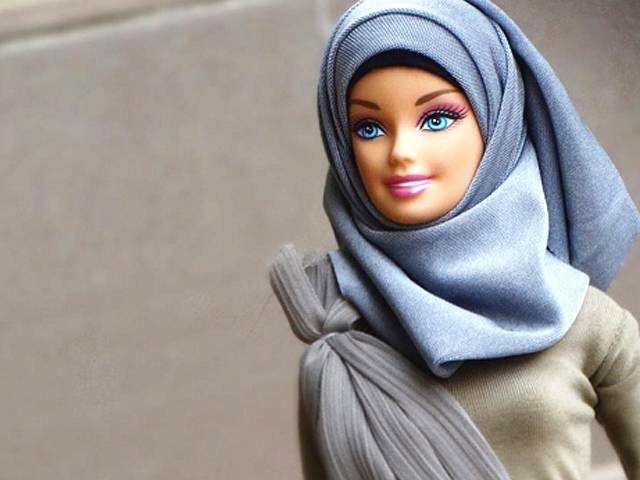
The 'Hijarbie', created by 24-year-old Haneefah Adam, will be initially available in the US and will be sold in the UK from mid March. PHOTO: THE ECONOMIC TIMES
Let’s open a can of worms (an interesting exercise if indulged in occasionally) and wonder what it would be like if Barbie (of Ken fame) came to Pakistan as a franchise.
Since a non-Muslim woman before being co-opted into a Muslim family must become Muslim and change her name, Barbie, before being launched in Pakistan must do the same. I speak of Pakistan which rejoices in the name ‘The Islamic Republic of Pakistan’ as of a family, however dysfunctional, and of Barbie as a sort of Qaum ki bahoo, (the nation’s daughter-in-law) which puts Sania Mirza’s nose out of joint.
It’s weird that Barbie would have to change her name considering the number of Tonys and Pinkys and Annies in Pakistan but the Tonys and Pinkys and Annies of Pakistan come backed with something like Tanveer and Parveen and Quratul Ain which koshers them, so to speak.
Barbie, on the other hand, comes backed with Mattel which is owned by Ruth Handler, a Jewish lady, and although they’d keep that quiet if Barbie came to Pakistan as a franchise, Barbie would be renamed Bubblee to preserve Pakistani sensibilities.
Bubblee in Pakistan would look like, well let’s just say she would look as though she’d been poured into her clothes and forgotten to say “when”. Okay, that was lifted straight from PG Wodehouse but I couldn’t have described it better because she’d need a touch of Aruj TV and impossibly blonde hair to make it in this place.
In Pakistan then, the Bubblee doll would come complete with an extensive wardrobe, and the following accessories.
1. A chaste white hijab for prayers.
The original design included little silver discs sewn into the edging which clashed together and made a noise that tuned out unmelodious azans (call for prayer), but it was still rejected. The accepted design would include tiny silver minarets with large pink loudspeakers stamped all across the edge.
2. A shiny pink vanity case complete with purple lipstick for parties, a pale nude for prayers, and a bright pink for all other times.
There would be besides several bottles of nail polish, required since water does not permeate polish and renders prayers invalid so the polish needs to be changed five times a day. There’d also be a bottle of attar, not scent since Estee Lauder was Jewish too and therefore, haram. Really they do crop up. Oh and there’d also be a tube of fairness cream.
3. A cell phone, since no self-respecting person these days is seen without a cell phone and Bublee, is a respectable doll.
There’d be some controversy regarding which car Bubblee should drive. The issue would create much discord amongst the masses so it would be decided that Bubblee should drive a Honda Accord. Not that the Accord is a particularly proletarian choice but Bubblee stopped being proletarian after being poured into her clothes.
Bubblee can be bought with a Ken, or to give him his Pakistani name, Kashif. Ken would not normally have been renamed because not being a woman he may keep his identity, but because Muslim women may not marry non-Muslim men, and Bubblee and Kashif if unmarried would come under the blasphemy line which is a competitor, the whole thing would be classified as, yes, you got it, haram.
So Ken is Kashif here, a name made up of two words: ‘Kaash’ and ‘If’, a good choice when someone has to marry a Bubblee.
Kashif comes with his own extensive wardrobe with the following accessories:
1. A cell phone
2. A nikkah nama
In packs that contain both Bubblee and Kashif this is a mandatory accessory. The document comes preserved in food grade plastic in case Kaash-if ever needs to eat his words.
3. A broom
When the need arises this is to be used to beat Bubblee lightly. It comes signed by the Council of Islamic Ideology (CII) and sealed with the CII stamp, a telescope circled by a moon and hatchet.
There was some debate once again, this time about how this last item could be reconciled with the fact that Pakistan is a signatory to the Convention on the Elimination of All Forms of Discrimination against Women, and someone suggested that a broom should also be included amongst Bubblee’s accessories to eliminate the discrimination against women. But that person has since gone into hiding and has been declared…haram, yes, because he does not possess a CII stamp but the CII would love to stamp on him.