Tuesday, August 23, 2016

CALLOUSNESS, NOT DECENCY

http://www.pakistantoday.com.pk/2016/08/22/comment/callousness-not-decency/

Riding side-saddle is as hazardous as it is rooted in a patriarchal mindset
Uzma fell off a skidding motorbike recently and almost broke her arms and legs, besides hurting herself badly in other places. Her son who was driving was unscathed for the simple reason that he did not fall off. Uzma fell because she was sitting sideways on the bike as all virtuous women in Pakistan must, so she slipped off as easily as water off a duck’s back when the bike skidded, which also describes the degree to which my strictures on the wisdom of sitting sideways will be heeded when next she sits on that bike. Who, after all wishes to be hooted and stared at by a public unable to bear the sight of a woman sitting in a posture it perceives as indecorous? Breaking an arm or a leg may be worse, but most people have short memories and when it comes to choosing between sense and convention they invariably choose the latter. What do you think though, isn’t it time this particular convention, a particularly idiotic one, was set aside?
If we can make laws regarding seat belts and bike helmets why do we not have a law making sitting sideways on a motorbike illegal, a practice that is responsible for so many injuries and deaths? After all, unlike some of its dimwitted neighbours, Pakistan does not prohibit women from driving cars and women drive cars with gusto here, sometimes with too much gusto. And to their great credit women now also drive rickshaws, and the country can even boast a female truck driver. And yet I have in the past ten years spotted only perhaps six women seated astride a bike, and maybe two driving bikes themselves. Otherwise almost without exception women sit sideways with no back support and nothing to hold onto except the driver of the bike himself. And if the driver happens to be that dreaded species of male, a na mahram (an unrelated man), the female passenger will not hold on to him either. If this were not precarious enough in this seventh most populous country in the world most women also balance a baby on their laps, with another child or two seated somewhere on the bike. This laden death trap then proceeds to weave through the insane city traffic and not surprisingly sheds its female passengers and whichever child might be perched on her lap at the first sign of a jolt.
Why pick up practices that have been proven not to work and discarded in other places? For example medication no longer used elsewhere? But this particular practice is especially distressing since more than anything else it indicates a disregard for the daily comfort and safety of women and children who have no other means of transport. Surely this tells us something about this society?
For centuries while horses were the principal mode of transport, women when they rode horseback sat sidesaddle. It was considered to be more modest and better for a woman even from the gynecological point of view, incredible as that sounds now. Before long though women realised that the practice which claimed to preserve their virginity failed to preserve their limbs, lives and independence, so they took to demanding greater security on horseback. A variety of adaptations were made to saddles to permit women to sit sideways with more comfort and safety. This included wider saddles with varying degrees of slope, additional pommels, different stirrups, and such things. The most practical change though was that women were eventually no longer forced to wear a conventional skirt which made riding astride impossible. They started wearing jodhpurs or breeches covered by an apron open at the back which became the new ‘riding habit’ as the dress was called.  But women still found it dangerous and difficult to ride sidesaddle on horseback (as it is if you try it), and eventually towards the beginning of the last century, riding sidesaddle began to go out of favour. Women now ride astride as do men, and the sidesaddle is now only a quaint anachronism, left over from a less practical age.
None of these adaptations have been attempted in Pakistan. None. In fact, the carrier behind the passenger’s seat which could serve as something additional to hold on to is generally removed by the owner of the bike because it doesn’t look good.
Segments of this society appear to hold firmly on to a twisted concept of modesty which only indicates an obsession with sex. In other words sexual perversion and callousness is being confused with decency. The two have no resemblance whatsoever to decency and the sooner we realise this and pay some attention to the safety of a sizeable if not major chunk of our population the better for all concerned.

Monday, August 15, 2016

PAKISTAN, OH PAKISTAN!

http://www.pakistantoday.com.pk/2016/08/15/comment/pakistan-oh-pakistan/

Should religion intrude on the turf of patriotism?
Midnight preceding 14th August isn’t a time any sane person would choose to leave home, but we were on the road to visit the home of a dear relative who had just passed away and gained her personal freedom from pain. The main Defence Boulevard, normally quiet at that time on other days was not quiet at all that night. Pakistan, launching on the seventieth year of its existence as a country independent of India, was commemorating the event but instead of doing so with renewed resolve to make Pakistan a better place, the citizens of Lahore had decided to embark on a night of chaos, mayhem and insanity. We watched as someone pulled a person…alive or dead we could not tell…from under a car on the other side of the road, the one approaching Defence. That car had driven against the direction of traffic and crashed into another vehicle coming up the correct side. In a city where people drive like demented non-humans…I will not specify which species…the innocent driver had yet not expected anyone to be quite this insane and had paid dearly for his or her optimism. And that was just the beginning.
Every male twenty five and under appeared to be on the road, either seated on a car window leaning half out of his car, or weaving in and out of traffic on a motorbike doing wheelies trailing enormous green and white banners on sticks, the poor discredited flag of this country. A small boy aged six or perhaps less had everything except a leg inside his car, his head missing adjacent cars by inches. Although one wonders at the child’s parents allowing him to do this maybe one should not since every adult behaved with similar heedlessness that night. That prodigious tide of cars and bikes carrying all this humanity on its back was not allowed to flow unimpeded. Law enforcement personnel in their wisdom forced it through frequent bottle necks with some vague notion of security. Where there were no bottlenecks there were cars standing across the road, blocking it. Behind them a sea of vehicles were ground to a halt for several kilometres, containing tired citizens on the way home, and perhaps sick persons on the way to hospital. And why were these cars parked across the road? Because the occupants had been attacked by zeal and fervor, something involving the glory of Pakistan and our willingness to die for it. They capered on the road performing some kind of celebratory dance in which it was possible to detect that twisted understanding of the ‘glory’ that is Pakistan. Just what else they were celebrating is hard to fathom unless it was a seventy-fold increase in madness, seeing that every law was being trashed that night along with a sublime disregard for human life and security.
Pakistan O Pakistan! Beautiful thy spacious skies
Its amber waves of grain
And purple mountain majesties
Above the fruited plain!
Pakistan! Pakistan! God shed His grace on thee
And yet art set to destroy the good
And mock thy liberty
 (Generously borrowed from Kathleen Lee Bates)
When will this change? Can it indeed, unless the narrative fed to this country with every morsel, each word and sound, changes? Do we really need to hear the constant refrain hum Pakistan pay mar mitnay ka irada rakhtay hain (we resolve to die and annihilate ourselves for the glory of Pakistan), particularly given the mood these days? Where are the songs that glorify peace and security, the stories containing heroes who might be exemplary leaders, humanitarians and plain hard working citizens who manage not to break every law in the book?
Dying for a glorious cause is a great act, the ultimate sacrifice, and no one denies that, but it is a sacrifice made when all other solutions have fallen through. There is also the fact that the hereafter is not the only facet of existence. There is the here and now and one ignores it at one’s peril. Focusing exclusively on ‘glory’ is the practice of those with a particular, rather undesirable view of religion and somehow this religious perspective has been confused with patriotism. Those who build narratives for this country need to ask themselves some questions quite seriously, such as: Will it dent the the hereafter if we also concentrate on getting this country on its feet today? And the other all-important and rather explosive question: Should religion intrude on the turf of patriotism?
Let us all be brave enough to die the death of a martyr, but let no one lust for martyrdom.
Gandhi.
So true. And no, I am not an Indian agent. Gandhi was a great man, as was Jinnah. And so can Pakistan be a great country if our youth are guided towards good citizenship and provided with positive avenues for venting their energy.

Wednesday, August 10, 2016

DEAR GOD, WHERE'S MY T-SHIRT?

http://blogs.tribune.com.pk/story/38619/dear-god-wheres-my-t-shirt/


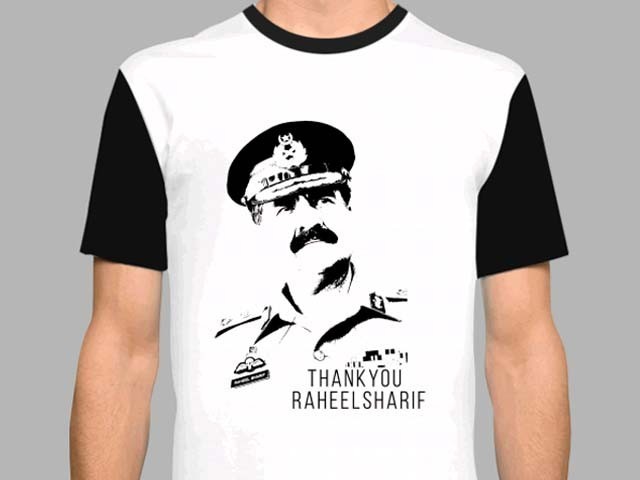
There are now T-shirts out there with that man Raheel’s picture on them. God, this is too much! I am the PM not he! PHOTO: THE WAREHOUSE
Dear God,
I have a serious complaint to make. You must know… but of course you do… that there are now T-shirts out there with that man Raheel’s picture on them.
God, this is too much! I am the PM not he!
Why have you allowed this to happen??
Please God, remember that I am still weak although I don’t look it, because I have just had avery big operation and although many people don’t believe it (they say I went to my London apartment in Mayfair… how delicious that sounds… just to hide when that stupid Panama information leaked out but you know I didn’t, it was just lucky timing), if anyone needs proof, I can show them where they cut my chest open and did things to my heart like how it was done before Shab-e-Mairaj, and no I’m not trying to go that route, I leave that to Mr Improper Khan, and to that Tahirul Dharni who is back again, and that quack na- Liaquat.
Look, I try as hard as that Raheel man but I can’t help it if I don’t have a smart uniform and if my public image creating bunch is not as good as his ISPR… but T-shirts! What about me, God, where’s my T-shirt? That’s my electorate out there that will be wearing his shirt! We made all those trains and roads and bridges and I just said goodbye to the IMF so impressively.
Did nobody read or hear what IMF’s Harald Thumb, sorry Finger, said about Pakistan’s economy doing well? Finger said (really, these goras have the strangest names) he was satisfied, that we have lots of construction activity and a good private sector credit growth, and more investment because of the Chinese corridor. I want to mention other good things he said too, but the bijli has just gone so I can’t read this list. I will read it and tell you when I get home because the bijli never goes in my house, and in Shahbaz’s house, and the houses of my colleagues and friends. But of course you know all that, God. You know everything.
So you also know about my government computerised NADRA, and we can now check to see if we have any strange people in our family tree. Many people called NADRA to say they had many strange people in their family and asked NADRA to help get rid of them but NADRA had to tell them they were talking about illegal people and terrorists, and those sorts of strange people, not their in-laws.
See what we have to deal with?
If I was like that Raheel man and his colleagues, I would settle everything with a gun but we don’t settle things that way, we settle for not settling them at all. Anyway, why use guns when you can use money? And cunnactions?
Guns are so passé. Ha. I learnt that word from Tehmina. Maybe she used it in one of her books. They say her last one about silly things in sorrow times or something like that was awful, so maybe one of her other books? Anyway, she told me that word and I memorised it. Passé. I like that word. It means ‘purani baat’(old news).
Like Zardari sahib, yaar woh passé ho gaye hain (Man he’s become so passé). Hehe. Or like recently when someone asked me about the Panama foolishness as I stood at the podium, I waved my hand (which has dimples on the knuckles, seriously, they’re so cute) and said carelessly: That’s so passé.
Let’s talk about the PCEC instead, the Pak-Chinese corridor thing, one of my many achievements.
That was so definitive, and I tried dropping the mike after that like Obama did but my bodyguard, who’s always trying to get on camera, caught it before it hit the floor, the idiot.
And now August 14th is coming up and I have a speech to deliver, a nice one that begins with ‘meray aziz hum watnon,’ (my fellow citizens) but I have to think of what to say after that. I can’t talk much about Kashmir except promise a resolution and say Kashmir will come to Pakistan, whoop, whoop, although really they don’t want to be part of Pakistan (don’t say ‘who would?’) as much as they don’t want to be part of India. Also now that Singh fellow and our Chaudhry had those words at the SAARC meeting and Singh stormed out. If he’d stayed and tried some of our biryani he would have said,
‘Take Kashmir, just give me this recipe’, but he left without having lunch.
There’s all these factories closing down because they don’t have enough cunnactions (bijli wallay) so I can’t talk about industries, and if I say anything about the militants and terrorists someone or the other will get upset and there will be dishoom dishoom (bang bang) and I don’t mean the movie. Really I would just like to say,
‘Meray aziz hum watnon, I WANT A T-SHIRT TOO!’
After all I’m just as pretty as that Raheel man is, more than he is, I have dimples, and not just on my knuckles I also have a big one on my chin, he has none, although he may have some but not where we can see them. As for mine, my mother used to do meray dimple ka sadqa and distribute nihari all over the muhallah; I wonder what his mother did? But Shahbaz tells me I can’t say that either. Boo. Really, it looks to me as if now I can’t do or say half the things I used to be able to, I keep falling over that Raheel man. You’d think he was ruling the country not I,hain ji?
Oh well. There’s still time to think about my speech. After all, life is so unexpected. Who could have said just a few days ago for example that a plain old Pakistani would make such a difference to the American elections lead up as that Khizr Khan and his wife? I mean other than anything else, that Trump knows very little if he thinks us Pakistanis don’t allow our women to speak. Lo ji! No one can get that Asma Jehangir to shut up, although recently she did say that the,
‘Panama Papers leak should not be used to introduce a ‘parallel system’ in the country,’ a useful thing to say, if only she had not added that she was one of my fiercest critics.
She needn’t have said that. And then there’s my daughter who talks incessantly in tweets as women should; and that Mazari lady who’s no Tweety bird but she can talk too.
So, God, please get me a T-shirt too, meray dimple ki qasam, and please also tell me what to say in my Independence Day speech. Should I mention that the army is getting too up itself, but that no one understands why that should just not happen, that really it comes under my government’s command and not the other way around? Shahbaz says I shouldn’t and I want to win the election, almost as much as I want that T-shirt.
So thank you, God, I’ll wait for your advice.
Nawaja out.
Note: This piece is a work of satire *                      
*author's note: I love it that they had to make this disclaimer


Monday, August 1, 2016

HERMIONE IN A MADRESSAH

http://www.pakistantoday.com.pk/2016/08/01/comment/hermione-in-a-madressah/

Effective education and even handed justice are both crucial.
 To be just and effective a law, bill or ordinance must be accompanied by effective implementation, always presuming that the law itself is well drafted which it not always is, as for example in the case of the Qisas and Diyat ordinance (remember the Raymond Davis case). Poorly implemented, ill drafted laws reduce justice to crime and inappropriate punishment. It is the same with education which if unsupported by effective teaching and well written and attractively presented books produces little more than basic literacy. This is the case with Pakistan’s government schools and many private schools.
In any case laws can only go so far. Laws against honour killings, against violence, gender discrimination and sectarianism are little more than deterrent, some less effective at deterring than others. It is impossible to disagree with the argument that genuine change comes with education because education effects the way people think. And yet education in Pakistan is so lacking in tools, trained teachers, books and curricula.
As a new recruit to teaching young underprivileged girls spoken English I tried to introduce my students to alien environments using simple English books, explaining them as I went along. Harry Potter took a lot of work and is not worth the effort if time is limited. There was little interest in the story itself, and only in some of the events; I learnt more about my students during the exercise than the students did about the Potter world. The concept of a headmaster and teacher being involved in a child’s life was alien but the idea of an ill-treated orphan sleeping in a cupboard under the stairs was not. Hogwarts was of interest. ‘That’s a school!’ the girls exclaimed. And ‘Such a large building!’ when I showed them pictures.  The concept of a boarding school was novel until one girl waved her hand dismissively. ‘Like a madressah,’ she said, and well yes, madressahs often include boarders, although it’s hard to imagine Hermione in a madressah where Snape would fit right in.
Used as they are to religious stories and little else even in their English curriculum our children do not lack imagination but are unused to using the faculty. They also lack the experiences in their daily lives to make the exercise easier.
Literature for all children but particularly disadvantaged children must take this and several other factors into account. If no effort is made in this respect there is nothing but the existing prosaic moralising texts to fall back upon, with the attitudes that accrue from them.
A writer involved in producing books for children spoke about writing a story in which the characters were animals that spoke to each other. The board appointed to evaluate her manuscript rejected it saying that she was teaching the children lies, because ‘animals do not talk!’ These are the attitudes that accrue from dull moralising texts.
Children need stories that interest them, stories they can relate to. If writers are restricted by people who lack imagination and are hemmed in by taboos they are left with nothing but prosaic moralising, although organisations like the Oxford University Press are producing some wonderful material. This is not the material used by government schools however.
Pakistan is host to many issues as most countries are. We are plagued by sectarianism, intolerance, bigotry, gender discrimination, yet our teaching, based on rote does not encourage enquiry and debate. With some thought each of these issues can be addressed.
In the US following the assassination of Martin Luther King a primary school teacher at an all-white school located in an all-white neighbourhood initiated a school exercise with her third grade students. She divided the class into two groups, one composed of blue eyed kids, the other of brown eyed kids. One day one group was given privileges the other was deprived of. The other day the groups were reversed along with the privileges, simulating a situation created when one race considers itself superior and possesses privileges other races do not. The experiment led to tears in some cases but in almost all the children learnt a lesson about racism by experiencing it firsthand. The adults interviewed years later described how these lessons about racism learnt in childhood had stayed with them all their lives, and how because of that experiment they were able to empathise with those who suffered racism.
In such ways each of those issues mentioned above can be tackled, doggedly, systematically, a zarb-e-azb against ignorance and regressive mentality. Justice and transparency are being denied to the people of Pakistan, the police resists registering FIRs, murderers are able to buy their freedom, the Hudood ordinance requires four eye-witnesses to rape although not everyone is raped in the middle of the street. Qandeel’s father by registering an FIR himself citing his sons as his daughter’s murderers on the report perhaps intended to pardon them later. Who knows? The laws are there to support him. The police often does not take cognisance of cases that have no complainants (where is the State in such cases?), the Capital Gains Tax will not as of now be applicable to property sold by members of the armed force (why?? Are they not citizens of Pakistan?), and not mentioned yet is the ill-conceived Cybercrime bill which gives the State (a State that does not use the powers it already has when it should) further powers it should not have.
In just such a way a decent education is being denied to the people of Pakistan. That education must be forced out of the State and system, as when an FIR was determinedly lodged against Senator Hamdullah for abusing Mervi Sermid, as when the State became the Complainant against Qandeel’s murder, to prevent her family from pardoning her murderers.
The education we possess at present is so startlingly backward, irrelevant and inadequate, and so hostile to women that the Hermiones of Pakistan have a hard time surviving in normal schools much less madressahs and many of them end up dead, victims of that so called ‘honour’ that Pakistan appears to possess and lovingly nurture by means of its education and laws together.

Monday, July 25, 2016

THE SPECTRE OF FETHULLAH GULEN

http://www.pakistantoday.com.pk/2016/07/25/comment/the-spectre-of-fethullah-gulen/

Should education in Pakistan be held hostage to politics?

An often heard phrase when visiting Turkey is: ‘’Turkey, Pakistan, ‘brother brother’.’’ But Turkey, Pakistan’s brotherly neighbour is somewhat troubled these days. Following a failed coup attempt against his government, President Erdogan has clamped down on those segments of society he perceives as being involved in the coup. As a result the Turkish ambassador in Pakistan has requested that all schools set up under the aegis of the Pak Turk Education Foundation in Pakistan should be closed. The reason Erdogan’s government wants these schools closed is that they are suspected of having ties to Fethullah Gülen  the exiled Turkish cleric, and of being run by the Hizmet movement set up by Gülen .
The Pak-Turk Education Foundation, which was awarded the Sitara-e-Eisaar by the President of Pakistan in 2006, runs schools in several countries around the world. Twenty eight of these schools are in Pakistan in Islamabad, Lahore, Quetta, Karachi, Hyderabad, Khairpur and Jamshoro, and have been since 1995. The schools employ some 1,500 trained teachers with an enrolment of around 10,000 students from pre-school to A levels. They are affiliated with the Federal Board of Intermediate and Secondary schools as well as with Cambridge for O and A levels.
The management of the schools disclaims any affiliation with the Hizmet movement or with any other political, religious or denominational movement stressing that the schools are ‘a philanthropic and non-political endeavor established for human development in the field of education for the benefit of all Pakistanis, especially the poor, needy and deserving sections of the society.’ They ‘provide necessary facilities in order to enable (students) to gain access to resources for productive self-employment and to encourage them to undertake activities for income generation and poverty alleviation to enhance their quality of life.’ The management further states that these schools provide ‘affordable quality education to all segments of population across the various regions of the country with significant amounts given as scholarship to the deserving students so that they may pursue their dream of getting a high-quality education.’
There has been no reason to doubt their word. No student from these schools has been involved in terrorism or any such activity in Pakistan; the Turkish government’s reservations regarding their involvement in the coup are based on suspicion, as a result of which the President has signed a decree closing down all institutions suspected of links to the Gülen. That means that 1,043 private schools, 1,229 foundations and associations, 35 medical institutions, 19 unions, and 15 universities will be shut down and their assets seized by the treasury. 
Although the schools disclaim any connection with him, here are some facts regarding Muhammed Fethullah Gülen: according to Wiki, Gülen  is a Turkish preacher, former imam, writer, political figure, founder of the Gülen movement known as ‘Hizmet’ which means ‘service’ in Turkish, and also the inspiration behind Hizmet’s largest organization, the Alliance for Shared Values. Gulen himself currently lives in self-imposed exile in the United States.
Gülen teaches a moderate version of Islam, and states that he believes in science, interfaith dialogue among the People of the Book, and multi-party democracy. Gülen is actively involved in debate concerning the future of the Turkish state, and Islam in the modern world. He has been described as an imam “who promotes a tolerant Islam which emphasises altruism, hard work and education” and as “one of the world’s most important Muslim figures.’’
If Pakistan does indeed give in to pressure from the Turkish government, the move will be ironic, given the number of madressahs currently operating in the country with established links to political, religious or denominational movements that have a more than suspected record of terrorism, violence and spurious religious indoctrination. Prominent among these is the Lashkar-e-Tayyaba (LeT) which we can use as an example. LeT is a group banned in several countries and officially so in Pakistan, yet, the South Asia Terrorist Portal and Institute for Conflict Management report that the LeT continues to operate in Pakistan from its ‘200 acre headquarters at Muridke, 30 kms from Lahore, built with contributions and donations from the Middle East, with Saudi Arabia the biggest contributor.’
The headquarters at Muridke includes a madressah, hospital, market, large residential area for ‘scholars’ and faculty members, fish farm and agricultural tracts. The LeT also reportedly operates 16 Islamic institutions, 135 secondary schools, an ambulance service, mobile clinics, blood banks and several seminaries across Pakistan. It is known for its hard line views on religion.
LeT publishes its views and opinion through a website, an Urdu monthly journal Al-Dawa, and an Urdu weekly, Gazwa. It also It also publishes Voice of Islam an English monthly, and Al-Rabat a monthly in Arabic, as well as Mujala-e-Tulba an Urdu monthly for students, and Jehad Times an Urdu Weekly.’
The alleged founder of Lashkar-e-Tayyaba Hafiz Muhammad Saeed is a man internationally wanted for terrorism connected with several terrorist attacks such as the November 2008 attack in Mumbai, who lives in a fortified house in Lahore.
While the majority of madressahs in Pakistan may be innocent most of them teach an extremist and distorted brand of religion and little or nothing else. According to a report by the Brookings institute dealing with these madressahs, ‘With no state supervision, it is up to the individual schools to decide what to teach and preach. Many provide only religious subjects to their students, focusing on rote memorization of Arabic texts to the exclusion of basic skills such as simple math, science, or geography. Students graduate unable to multiply, find their nation on a map, and are ignorant of basic events in human history such as the moon landing.’
So here’s the thing, since the government is said to be in a bit of a bind right now about how to deal with the situation in a suitably diplomatic fashion: With a population of over 199,090,000, Pakistan is the world’s seventh most populous nation with an average literacy rate of around half its population, less than half for women. Given such figures (or even otherwise) why should education in Pakistan be held hostage to politics, particularly the politics of other countries, however brotherly? That as well as a comparison of the personalities involved is a question that the Foreign Office should take into account when choosing a response to Turkey’s demands that Pakistan should shut down the Pak Turk Education Foundation schools on its territory.


Monday, July 18, 2016

THE ONLY WAY TO WIN

http://www.pakistantoday.com.pk/2016/07/18/comment/the-only-way-to-win/


Make peace not war
Derek Miller writes in the Guardian about the Strategic Bombing Survey produced by the US following the Second World War. The Survey summarised itself by recommending two important things: 1) “The great lesson to be learned in the battered towns of England and the ruined cities of Germany is that the best way to win a war is to prevent it from occurring.” 2) That for times of peace as well as in war, ‘’the highest possible quality and stature of personnel are to man the posts within any such organisation … quality, not numbers, is the important criterion.’’
The Second World War resulted in the death of anything between fifty to eighty million people. Given world population figures at the time that would be approximately three percent of the entire population of the earth, or more. Over two million of these persons were Indian.
It took seven years and cost more than ten million pounds for the Chilcot Report to emerge, all twelve volumes of it in the UK. It represented some slight acknowledgement of what the war in Iraq really was: a ghastly crime. About Britain’s choice to jointly invade Iraq with the US the Report says ‘the UK chose to join the invasion of Iraq before the peaceful options for disarmament had been exhausted. Military action at that time was not a last resort.” About the role of British Administration in post war Iraq it says, ‘’Whitehall departments and their Ministers failed to put collective weight behind the task.”
As a direct result of the Iraq war over four million persons were displaced from Iraq and within it, and over a hundred thousand civilian and combatant deaths took place; the victims included men, women and children. There was malnutrition in Iraq, and abuse, torture and death in prisons such as Abu Ghraib. There have been other even more far reaching consequences of this war such as a sharp escalation of sectarian conflict and extremism both within Iraq and in other countries in the bloc, and the spillover of this conflict into the rest of the world, a process that began with the Soviet invasion of Afghanistan, and Iraq’s invasion of Kuwait. This worldwide violence, or terrorism as it is now better known is causing as many casualties as the war, and is likely to cause countless more unless something is done to prevent it. I use the word ‘prevent’ rather than ‘stop’ quite deliberately.
The lessons that ought to have been learnt, that were enumerated and pointed out in both these reports are being disregarded. Will we as a country, learn anything from the terrible consequences of the Iraq War and the wars before it, consequences which are there for everyone to witness and suffer through? Will we learn from the Chilcot Report which points out all the errors that were made, even though its remit is restricted to Britain?
Both reports lay stress on the quality of personnel, administration and leaders in war and in times of peace. Eventually they both state in no uncertain terms that war must be a last resort, something that must not indulged in unless all other avenues are exhausted.
In Pakistan the attitude towards the military and confusion between civilian and military roles is a clear indication that violence remains an easy and convenient option. We have never been more wrong. War is like the fire that feeding on the hearths of a myriad individual homes grows to mushroom over the entire world.
This is not an attempt to hand Pakistan the blame for the violence so prevalent today because Pakistan alone is not responsible, not by any means. But we must each mind the tiny fires we start at home to prevent a conflagration, and we must do this now. We may not be able to stop the George W Bushes or Tony Blairs of this world but one can attempt to stem the tide of militancy that has burgeoned right here in response to their actions, and if nothing else prevent a convenient excuse for war from being made available. Recent violent events in Belgium and France for example provide just such an excuse. It is unclear whose hands this is playing into, probably more than one, but the end result is always the death of innocent persons in massive number.
You’d think that the West would learn some lessons from the reports pushed under its very nose, but their response seems to be a retreat into greater conservatism, as is ours. The world appears to have become wary of the liberal path and the Trumps, Mays and Johnsons, and even Clinton who voted for the Iraq invasion, have centre stage which is the last thing that this war torn world needs. As much does the world need the Taliban and other so called ‘Islamic’ militants.
In a geopolitically sensitive country like Pakistan where are the ‘highest possible quality and stature of personnel’ to man sensitive posts? And the focused collective effort to invest in Pakistan and its long term prospects, for peace in the country, in the region and in the world? Instead the Prime Minster retains the portfolio of foreign affairs to himself, a particularly foolish brand of hubris, a statement justified by the results it has produced.
Above all in the supremely overarching sense where are the attempts to teach peace and alternatives to war in schools and the debate on those subjects at any level of education? The youth of this country is being liberally fed on misguided concepts of religion and world affairs, supplemented by a hefty dose of rabid Friday sermons. Bangladesh by the way is clamping down on those sermons following the spate of terrorist attacks on its soil. Ours is hardly the way to prevent conflict.
If another war is what the country desires it can be available any time. But it is peace we need, and it is peace the country wants. War is just what the very few desire. Sadly though the few might win the day and get what they want at this rate.

Monday, July 11, 2016

THE MAN WHO LIVES

http://www.pakistantoday.com.pk/2016/07/11/comment/the-man-who-lives/

‘People prefer a familiar suffering due to fear of the unknown,’ Thích Nhất Hạnh (Vietnamese Buddhist monk and peace activist)
Liberal, secular and logical are among the most hated and misunderstood words in Pakistan, used particularly by those who like to call themselves religious to condemn anything rational and alien. They forget or more likely have not considered that the Prophet of Islam, Muhammad (PBUH) preached a religion which was astonishingly liberal for that and all other times, a way of life with rationally logical systems that when applied, worked towards improving the secular existence of man as well as his hereafter.
Although Christianity and Judaism existed, Islam’s stress on monotheism was a startling step away from the polytheism that was the mainstream religion of the society it was born in the midst of. Its insistence on tolerance and kindness towards those with differing views was not a common aspect of society at the time, and not everywhere even now. Its injunctions on dealings with women, on treating them with kindness and consideration in general as well as in marriage and in case of divorce had no parallels in the contemporary society. With regards to treatment of the elderly, children, the disabled and sick, its views on education, the search for wider knowledge, economics, charity, courtesy, tolerance, justice, there was nothing about this religion that was not liberal if liberal is defined as a respect for people and opinions at variance with oneself, which is how it is generally defined. Islam, in short, has no place for the Tehreek-e-Talaba-e-Pakistans (TPP) and Ahl-e-Sunnat Wal Jamats (ASWJ) of this world, not for their divisive views or their violent practices. Islam does not discriminate against people based on their religion, race, sex or age.
It is because Islam is not taught from a balanced standpoint, and so much that is taught as supposedly Islamic is not in the religion at all that these terms (liberal, secular, logical) are so reviled. It is why that aspect of Islam is feared and therefore rarely debated, so we lose out on that point of view. In a male chauvinist, feudal society like ours egalitarianism is a threat, and so it is actively challenged. As Thích Nhất Hạnh said, ‘People prefer a familiar suffering due to fear of the unknown.’’ It is why feudalism still exists, infanticide is very much alive, and honour killings and other threats to women in society remain firmly entrenched, and why ‘outsiders’, people of other faiths and sects are so threatened.
Abdul Sattar Edhi was one of those deeply spiritual men who well understood the familiar. He preferred to dispel the suffering around him rather than live with it, and he worked tirelessly towards that end. Perhaps it is through him that we can understand what it means to be liberal, secular and logical which may allow us to study Islam and the teachings of Muhammad (pbuh) from that point of view.
Today, when we celebrate the life of this greatest of Pakistan’s humanitarians we must understand his work for what it was, as liberal, secular and logical as Islam itself. Edhi went about his work in the most logical way by simply doing what had to be done when he made up his mind to do it, trusting in God and people’s generosity to help him along the way and he had this help all along. The Edhi Foundation was supported by more private donations than any other charity. Edhi never accepted donations from any government, either his own or another.
Outside most Edhi centres there is a small baby cradle in mute appeal against the infanticide which is so tragically common in Pakistan. ‘Do not kill (the baby),’ the sign beside these cradles reads. ‘Leave (the baby) in the cradle.’ The cradles are often used, host to innocent babies who may otherwise have been killed or abandoned as a result of poverty, or social stigma following an illegitimate birth. These children are brought up in the Edhi Foundation’s orphanages.
Unfettered by narrow exclusionist views, Edhi extended a helping hand to anyone who needed it regardless of the religion, race, sex or age of the person he was helping. Not for Edhi the hatred associated with this country’s sectarian bias. His homes sheltered Hindu, Christian, Muslim, and Shia, Suni or Ahmadi men, women and children alike and there was no preaching or attempt at conversion. Once asked why his ambulance service was available to non-Muslims as well, he responded, ‘Because the ambulance is more Muslim than you.’
His tireless work has made Pakistan a better place for those who live here. The tremendous outpouring of love and grief at Edhi’s death is more eloquent than words of several things, of the appreciation the people of this country have for this man’s work. It also speaks better than any critique or analysis of the contrast between the people’s esteem for Edhi and for any other public figure in existence. It’s a lesson that wise persons would do well to note and learn from.
Edhi was not threatened by poverty, hard work or illness. He did not allow himself to be treated abroad for his last illness although the offer was made. Edhi was not threatened by his wife Bilquis who worked as hard right alongside him all their married life. Edhi was not threatened also by those who considered him an infidel because he was ‘liberal’. Many of those who fear the term and all it stands for admired Edhi for just those qualities which he possessed, although they have not succeeded in joining the dots. This may be the time for doing just that.
Edhi belonged to us in a way that nobody, and definitely not those who have property in Park Lane and public airlines at their disposal do. Edhi gave, and if he took anything from us it was always used for us, never for himself. Edhi belongs to us. We love you, Abdul Sattar Edhi, and thank you. You live on in our hearts.